Eventually the Diagram Required Geography
Eventually the Diagram Required Geography
We needed somewhere for the electricity to meet,
so we built land.
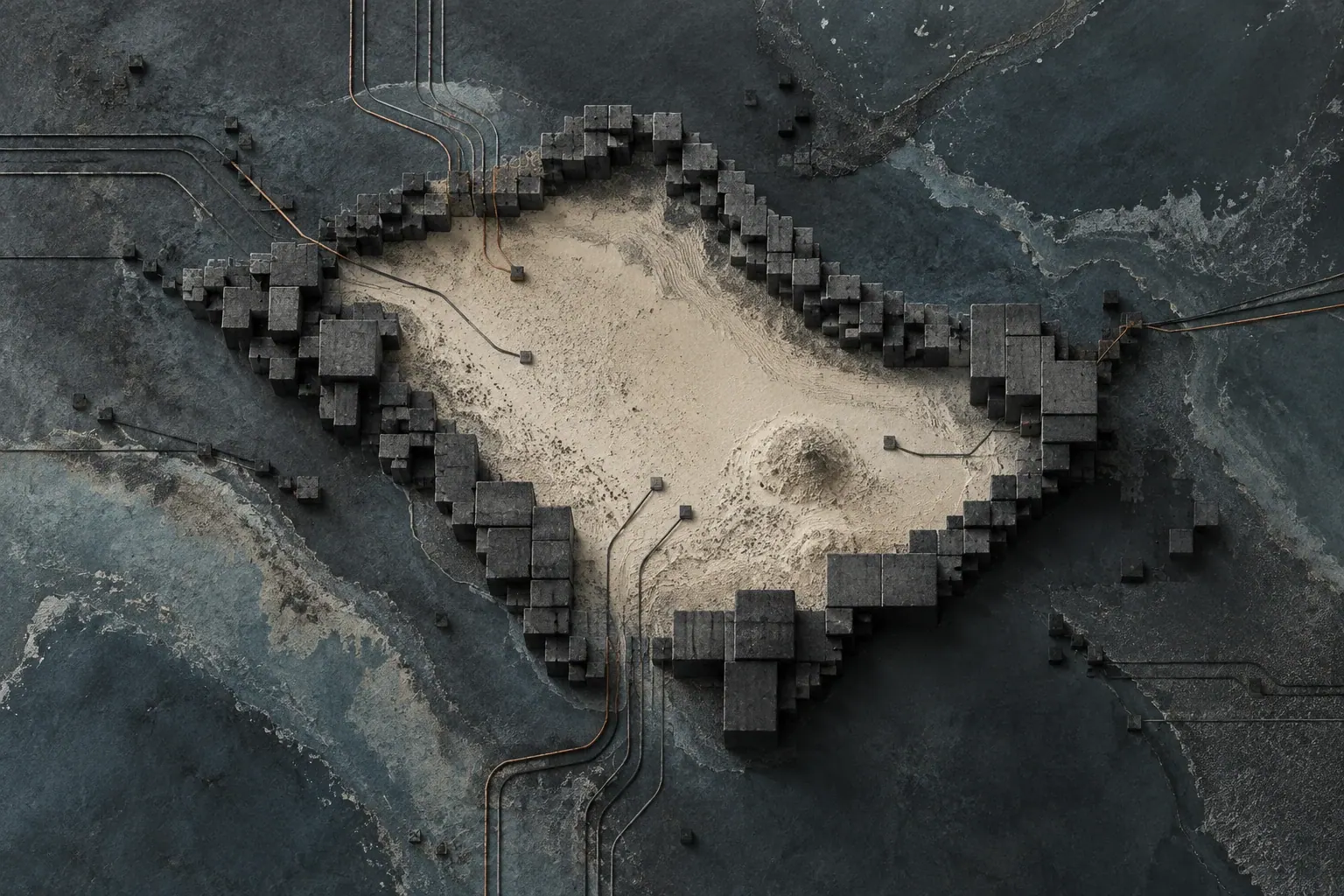
Belgium’s Princess Elisabeth Island is planned as an energy hub in the North Sea, almost 45 kilometers offshore. It will gather electricity from a new offshore wind zone, connect it to Belgium’s onshore grid, and serve as a potential junction for additional international interconnectors. The wind zone is planned for a maximum capacity of 3.5 gigawatts. (Elia)
The perimeter is made from 23 concrete caissons. Each weighs about 22,000 tonnes and measures roughly 58 meters long and 28 meters wide, with height varying according to the storm-wall design. They become an enclosure. The enclosure is filled with sand. The reclaimed interior then becomes the foundation for transformer stations, cables, and the other equipment of a high-voltage node. (Elia)
Not a building on an island.
The island is the building.
Material becomes unit.
Unit becomes array.
Array becomes perimeter.
Perimeter becomes land.
Land becomes node.
It is infrastructure for relation.
Wind farms → island → high-voltage equipment → submarine cables → grid → neighboring countries.
The individual caisson is impressive because it is enormous. Its real meaning arrives through arrangement. Twenty-three concrete members become an edge. The edge creates a place. The place exists so relationships inside an electrical network can resolve physically.
The project also treats the fabricated edge as potential habitat. Its nature-inclusive design includes ledges for cliff-nesting birds and underwater features intended to support marine life, reproduction, foraging, and shelter. (Elia nature-inclusive design)
That does not turn the intervention into untouched nature. It makes the category stranger.
Concrete becomes coastline.
Electrical infrastructure becomes habitat surface.
A diagram of generation, transmission, and exchange becomes large enough that it needs a location built specifically to hold its relationships.
At some point the built environment stops appearing to be merely inside the world.
It begins manufacturing pieces of the world.
Eventually the diagram required geography.
No marks yet.